



Lee este artículo en español
I am not a nutritionist; I am just a biochemist. Therefore, I’ll talk about creatine from this point of view, in a way that you will be able to tell when someone else is saying something right or wrong about this molecule.
What you will read below is largely based on a peer-reviewed review article written by Yuhui Su. I invite you to read it if you like, it is free to download.
Now let’s go to it. I have been watching YouTube videos where the role of creatine is explained. The main error that I have seen repeatedly is the notion that creatine is a source of energy. It is not. Instead, creatine is the Uber of energy. Creatine transports energy from one place to another. So, when you are taking your creatine for pre-gym workouts, you are not taking energy, you are taking the vehicle that facilitates its transport. With this I might be lowering the hype, but the role of creatine in muscle contraction is fascinating in any case, and I will explain why.
Let’s start with some analogies. Imagine that you are in your beloved off-grid house, in the garage, where you charge your batteries with solar panels. Would you take your batteries, weighing 100 Kg, from the garage to your living room to power your TV? Would you take the batteries back to the garage to charge them again every day? It is better to have a cable connecting your batteries to your TV, isn’t it?
This example is a bit exaggerated, but it does the trick. Creatine is like the cable—though unlike a real cable, it acts more like a shuttle that picks up energy packages and delivers them, then returns for more. Therefore, (and again) creatine is not a source of energy; it just transports it. In your cells, energy is produced mainly in your mitochondria from burning sugars and fats. This energy is stored in high-energy molecular bonds in ATP (Figure 1). Then ATP is used elsewhere in the cell to fuel a myriad of different reactions to maintain you alive. But what about your muscles? In some situations, our muscles need to react pretty fast. But ATP is not very fast when it comes to travelling throughout the interior of your messy cells. ATP is too bulky and charged to travel fast enough to the muscle contraction site. It is sticking everywhere. Creatine is smaller than ATP and can diffuse (swim) to the contracting muscle fiber more easily.
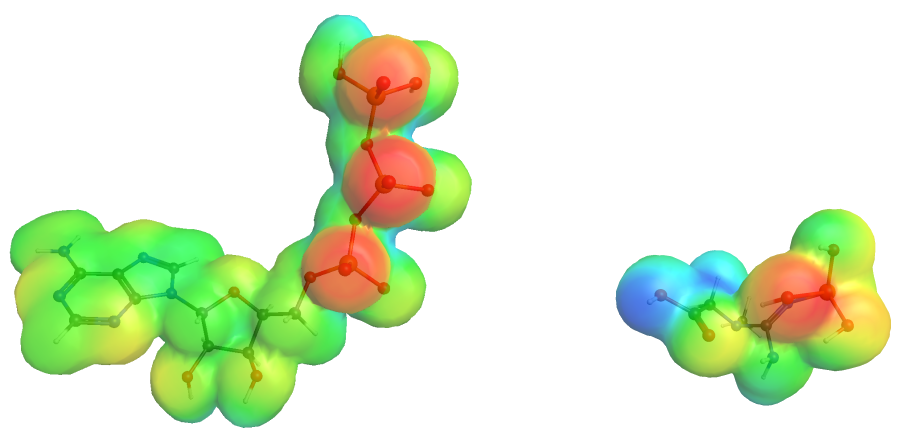
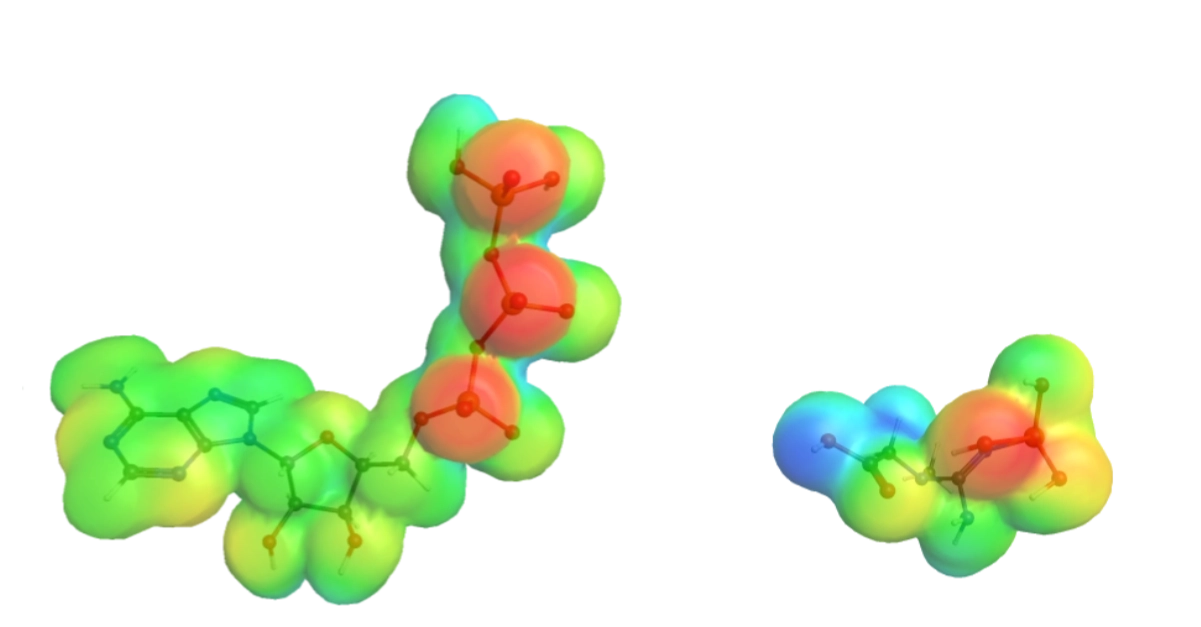
Figure 1. ATP (left) and phosphocreatine (right). Both molecules show their electrostatic potential, to give an idea of their size and the atoms composing them. See how bulky ATP (left) is. The red buble in phosphocreatine (right) is the phosphate captured and ready to go to the muscle fiber. Molecules generated using WebMo.
The trick works in this way: ATP is produced inside the mitochondria that surround our muscle fibres. As soon as it is produced, creatine picks up ATP’s high-energy phosphate group, like taking a “hot potato” (´facilitated by the enzyme Creatine Kinase), to become phosphocreatine. This phosphocreatine exits the mitochondria, travels by diffusion to the muscle fibre, and once there, transfers the phosphate to ADP, who is waiting like you wait for your pizza delivered on a FRiday evening. In this way, the ADP molecule becomes ATP, and phosphocreatine returns to be creatine. That’s it. A few thousands phosphocreatine swimming to the muscle to fuel contraction for a few seconds, just enough to escape from that sabre-tooth tiger.
I know, what a mess it is picking up a phosphate from ATP in one place, bring it somewhere else and hand it to a ADP molecule so it becomes ATP again! Yes, it is a mess, but it has made sense for millions of years. This trick is so popular in nature that cold-blooded vertebrates such as fish or turtles already had a similar system in place (Haagensen et al., 2008). In mammals, this creatine shuttle has evolved to become faster and more efficient.
Some more detail if you like
Now you are maybe asking: Then, why isn’t creatine used straight away to move muscles? Well, because ATP was already there, moving muscles millions of years before creatine appeared. ATP is pivotal in life since its beginning, and an organism cannot just change ATP for creatine because it wants to move faster. And take it as a literary license, because evolution does not think.
By the way, your liver produces creatine in the same form as the powder you purchase: Without any phosphate attached. Whether made by your body or ingested as a supplement, creatine travels to your mitochondria, where it picks up a high-energy phosphate group (proudly fueled by the burning of your own sugars or fats). This is where creatine becomes energized.
Another bit that maybe you want to know about: Your muscles contract when your nerves ask them to do so. Your nerves deliver a neurotransmitter to the muscle of interest, triggering an electric discharge that floods your muscle fibres with calcium. Calcium frees your muscle fibres from a ‘latch’ protein, thus allowing the party to start. Muscle contraction is like a bunch of people climbing a frozen cascade with an ice axe. The frozen cascade is the fixed part of the muscle; the climbers with their ice axes are the moving part of the muscle. At rest, all the climbers have their axes stabbed into the ice. When the signal comes, all climbers receive energy (yes, ATP) to remove their axes from the ice and stick them a step forward. Now, ATP has been used and converted into ADP. For the next stab forward, the ice axes bind a fresh ATP molecule, enforcing them to release from the ice and take another step. Over and over until the nerve decides that no more contraction is needed.
Now you can see why creatine is important. Phosphocreatine delivers its high-energy phosphate to reconvert used ADP back into ATP, so ATP amounts remain constant, and your little climbers can continue climbing.
In fact, the relative amount of ATP and ADP in your muscles is a source of information in itself. If your ATP levels cannot remain high compared to ADP, despite the efforts of creatine for keeping ATP levels high, the cell understands that it needs to produce more energy. However, this takes time, and now you are maybe leaning against the wall, trying to catch your breath.