



Lee este artículo en español
Introduction
If you know what a gene and an allele of a gene are, you are good to continue reading. If you need a brief refresher, take a look at the article gene and allele, how to tell the difference and come back.
The terms haplosufficient and haploinsufficient are adjectives, and are used as a sort of classification for genes; each gene is filed as one or the other. But how do geneticists know if a gene is haplosufficient or haploinsufficient? Well, for this, researchers need to perform lots of experiments. Since there is still a lot of work to do, you can guess that not all genes have been thrown to one or the other box.
The two main questions that scientists need to address to classify a gene as haplosufficient or haploinsufficient, are:
- Where in the body is the gene working (in which organs or tissues).
- How much work each tissue or organ demands of the gene.
Haplosufficiency
One thing we know: most genes in a diploid organism are haplosufficient (genes in sexual chromosomes are a whole different story). For a haplosufficient gene, it does not matter whether both alleles of the gene or only one of them is healthy and active. For haplosufficient genes the range of permissiveness in terms of required work is quite loose, as 50 % of work (one of the two alleles working and the other one not) is still ok to save the day (Fig. 1).
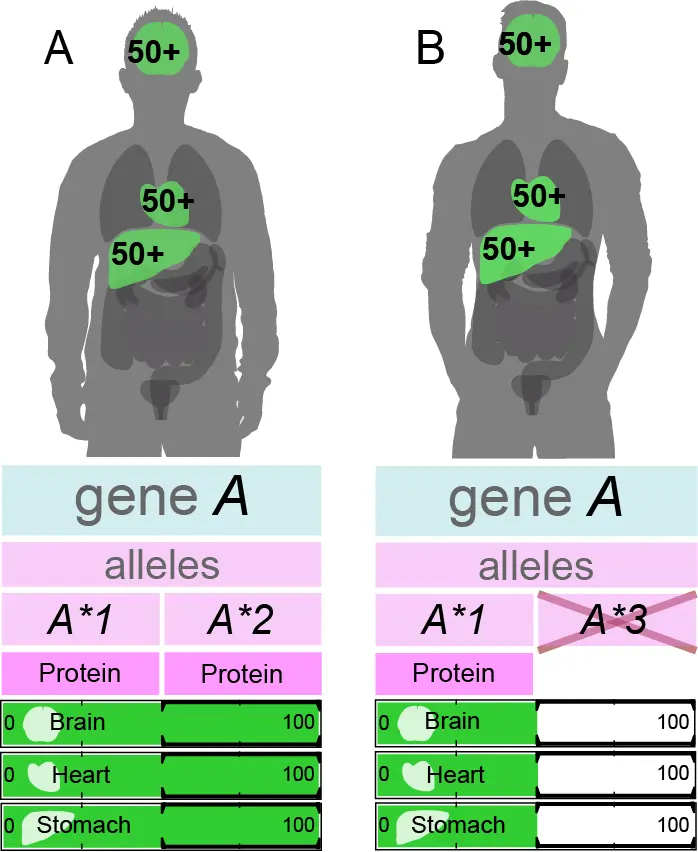
Figure 1. Gene A as an example of a haplosufficient gene (HS). This gene is active in brain, heart and liver. (A) A person with alleles A*1 and A*2, both working fine. In all organs where it is active, the minimum work required for this gene is 50 (arbitrary units), symbolised by the black triangles. As both alleles are healthy, their cumulative work is 100 (arbitrary units). Therefore, the work required of this gene is fulfilled in all the organs where it is active (organs filled in green). (B) In the person on the right hand side of the panel, one of the alleles does not work (allele A*3). Still, the work performed by the gene accounts for 50 arbitrary units (from allele A*1), which is the minimum required for this gene for the correct functioning of all organs where it works (organs still filled in green).
An example of a haplosufficient gene: GLUT2
The gene GLUT2 encodes a glucose transporter. This gene is active in the liver, the kidneys and the intestine. The disease that results from the failure of GLUT2 is known as Fanconi-Bickel syndrome (Santer et al., 1997). This disease only manifests when the two GLUT2 alleles fail. But why?
The liver delivers glucose to the bloodstream to provide fuel to the rest of the body when we are between meals. Similarly, the kidney reintroduces precious glucose into the bloodstream during the process of filtering ‘dirt’ out from the blood. The intestine, on its side, captures glucose and puts it out to the bloodstream when we are digesting a meal. Do you see a pattern here? GLUT2 is in the side of these tissues in charge of delivering glucose to the bloodstream.
Without enough functional GLUT2, glucose can’t leave these cells that are pouring glucose to the bloodstream. It gets stuck, and the result is that liver and kidneys keep it stored inside as glycogen and swell. The intestine has other ways to get out of this problem.
In this scenario, when one of the two alleles of GLUT2 is impaired, the remaining allele of GLUT2 still can release enough glucose to the bloodstream to prevent glucose overaccumulation and tissue swelling. Therefore, only complete absence of GLUT2 will drive a person to suffer from Fanconi-Bickel syndrome. You can see GLUT2 as a kind of ‘hero’.
Haploinsufficiency
Only around 5 % of our genes are estimated to be haploinsufficient (see below). What makes a gene haploinsufficient in a tissue is a volume of work higher than the work provided by only one of the two alleles. Therefore, if one of the alleles is damaged, the gene cannot meet the demand of this tissue. This leads to a disease caused by that gene, which is malfunctioning in that tissue (Fig. 2).
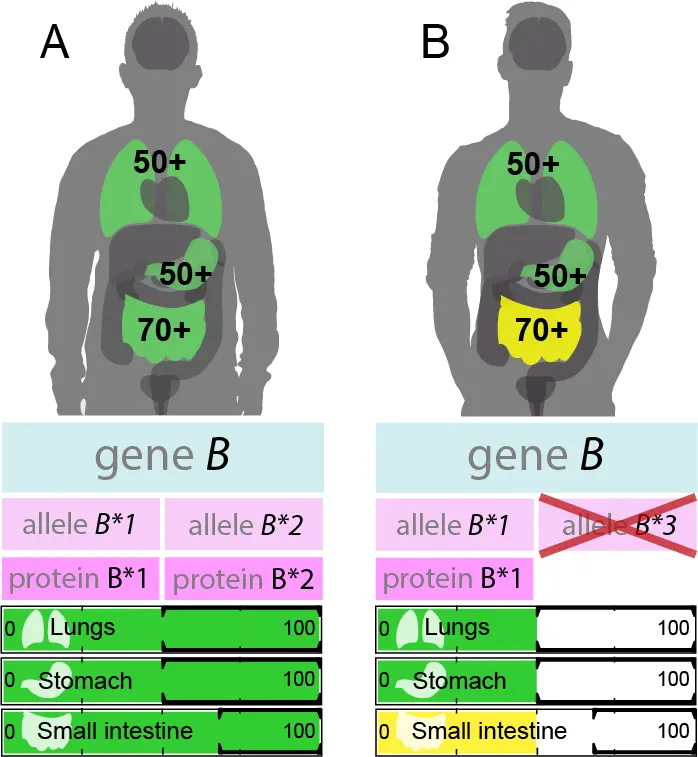
Figure 2. Gene B as an example of a haploinsufficient (HI) gene. This gene is active in lungs, stomach and small intestine. (A) A person with the alleles B*1 and B*2, both operating properly. Therefore, the work performed by the products of these alleles exceeds the minimum work required for normal function in all the organs where it is active. (B) A person with the alleles B*1 and B*3, where B*3 is not active due to a mutation. As a result, the total activity of the gene in this person is produced only by the healthy allele. As the minimum work required for the gene B is 70 arbitrary units in the small intestine, its function is insufficient in this organ, causing a disease.
The inheritance pattern of diseases caused by haploinsufficient genes is dominant
From the above, it follows that for a haploinsufficient gene, a significant loss of activity in one allele causes disease. Therefore, diseases caused by haploinsufficient genes follow a dominant inheritance pattern. In fact, haploinsufficiency is one of the main mechanisms behind dominant diseases. This means that if you inherit a partially defective allele of a haploinsufficient gene, it doesn’t matter that your other allele of the gene is healthy, you will still get the disease.
And now think about the other case. If a gene is haplosufficient, one healthy allele covers the demand, so a person with one broken allele is perfectly fine. The disease only shows up when both alleles fail. That is what we call a recessive disease, and it is exactly what we saw with GLUT2 and Fanconi-Bickel syndrome.
So here is the thing: dominant and recessive are words that describe what we see in families, but they don’t explain anything by themselves. Haplosufficiency does. Dominance and recessivity are not alleles competing with each other, as they are often taught at school. They are the visible result of a much simpler question: is half the work enough?
One clarification here. The above applies to diseases caused by a loss of function. An allele can also cause a dominant disease by acquiring a new harmful activity, or by interfering with the healthy allele. But that is a story for another day.
An example of a haploinsufficient gene: GLUT1
… In the brain
The glucose transporter GLUT1 (Fig. 3) is located in the brain, where it is the main mediator of glucose intake to fuel our cognitive function. It is well documented that when one allele of GLUT1 is not working, less glucose crosses into the brain, and that shortfall ends up as GLUT1 deficiency syndrome (Symonds et al., 2019). The most common symptoms of this syndrome, in different degrees of severity, are neurodevelopmental delay, epileptic encephalopathy, acquired microcephaly, ataxia, dystonia and spasticity (De Vivo et al., 1991).
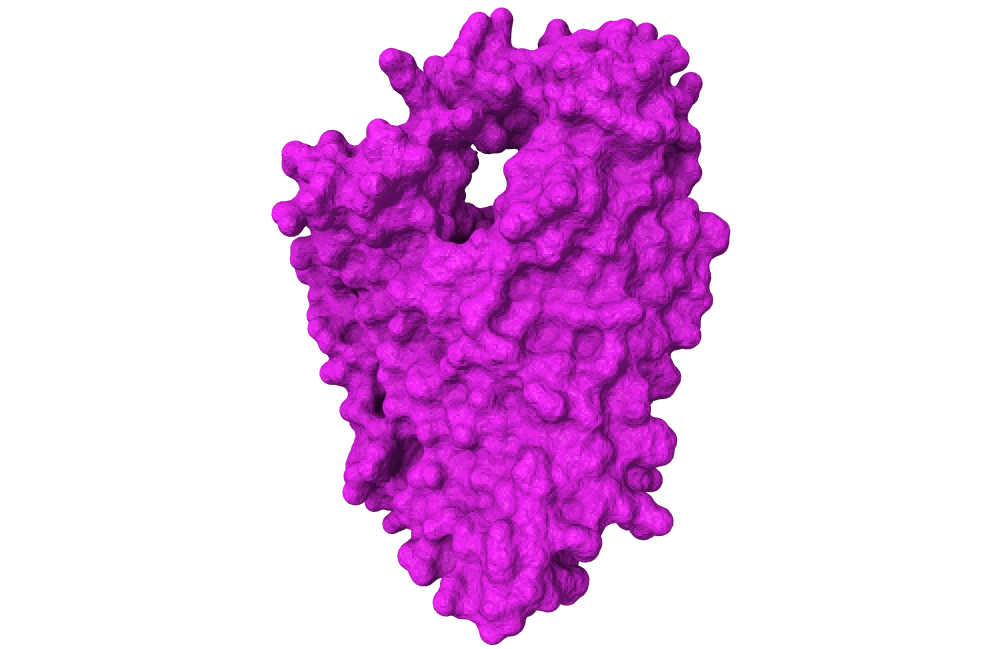
Figure 3. Human GLUT1 protein
The brain requires a minimum of 75% of the total activity of GLUT1 to stay on the safe side. If the work level of GLUT1 falls to 60%, GLUT1 deficiency syndrome appears with mild symptoms. If the work level of GLUT1 drops to 50%, the clinical symptoms will be severe (Yang et al., 2011).
… And in red blood cells
Red blood cells (erythrocytes) also use the GLUT1 protein. In fact, each red blood cell is packed with about 200,000 GLUT1 transporters. Not quite like the brain, erythrocytes are fine when only one allele of GLUT1 is working. Why? A possible hypothesis is that, even when only one allele is functional, the bone marrow still loads nascent erythrocytes with a lot (and enough) GLUT1 transporters. On top of that, in erythrocytes, GLUT1 does one more thing in addition to transport glucose: it uptakes oxidized vitamin C (Fig. 4) to convert it back to the usable form. Thus, two jobs and still enough GLUT1 even when one allele is nonfunctional! As you see, GLUT1 demonstrates the complexity of classifying a gene as haplosufficient or haploinsufficient.
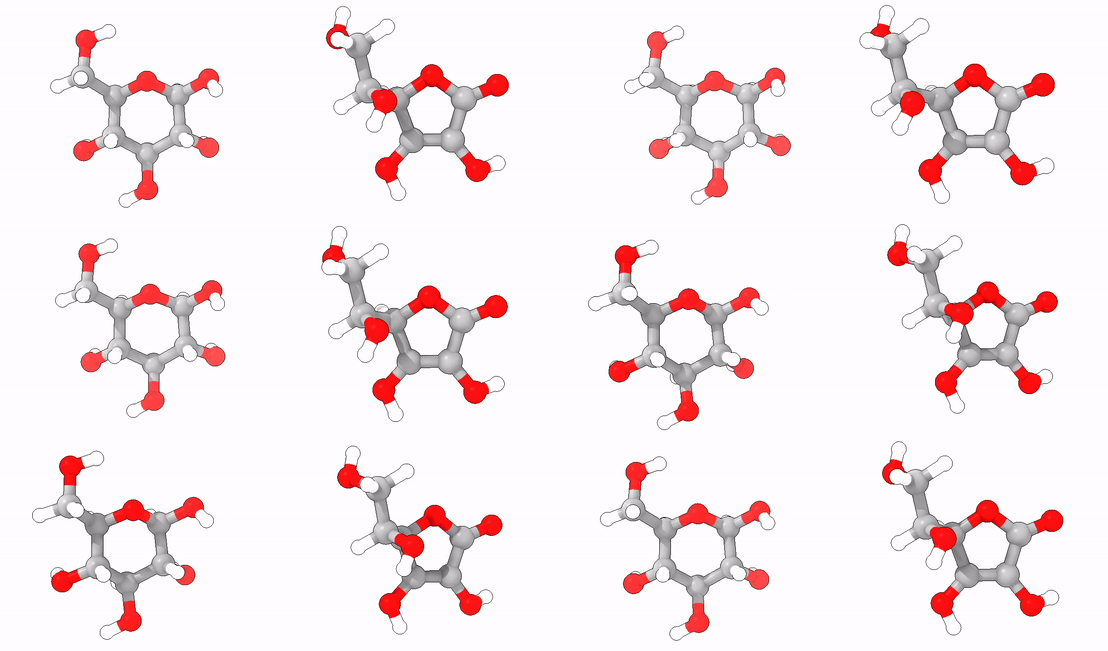
Figure 4. Glucose (left) and Vitamin C (Right)
How many haploinsufficient genes there are in the human genome?
The quick answer to this question is that it is currently unknown how many haploinsufficient genes exist in the human genome. Nevertheless, continuous research is making advancement in this field. In 2008, the group of M. A. Ragan collected in a review article the 299 genes for which there was evidence to classify them as haploinsufficient (Dang et al., 2008).
In 2010, the group of M. E. Hurles (Huang et al., 2010) developed a bioinformatics tool with the characteristics of the 301 haploinsufficient genes and the 1076 HS genes that were already known at that time. Next, they analyzed 12,443 well-known genes of the human genome not yet classified as either haplosufficient or haploinsufficient.
As a result, they assigned a probability of belonging to one or the other group. If we assume that the genes with a 90% probability of being haploinsufficient in this study are definitely haploinsufficient genes, then approximately 600 of the 12,443 genes investigated would fall into this category. Extrapolating this information to the 19,000–20,000 genes of the human genome, then approximately 950 genes would probably be HI. This accounts for about 5% of the total genes of our genome.
Recently, the way to answer this question has been reframed. Rather than sorting genes into two boxes, large population-sequencing projects Lek et al., 2016, Karczewski et al., 2020 suggest placing every gene on a continuous scale. These researchers looked at hundreds of thousands of healthy people and asked, for each gene, how often a broken allele turns up. Genes where broken alelles are almost never seen are genes evolution has been protecting.
But if we look at BRCA1, one of the best-known cancer-causing genes, this method finds no trace of evolutionary protection at all. This is not because losing one allele of BRCA1 is harmless, but because the damage usually appears after the age of having children, and evolution cannot act on what comes too late: That allele has already been passed on to the next generation.
Which brings us back to where we started. Whether a gene is haplosufficient or haploinsufficient is not a property you can read off the gene itself. GLUT1 is good enough in the red blood cell and merciless in the brain. GLUT2 is dispensable enough in the gut and indispensable in liver and kidney. The answer always depends on which tissue you ask, how much work it demands, and, as BRCA1 reminds us, when in life you ask the question.
That is why so many genes remain unclassified, and why this is still an open field.